
The Political Economy Research Centre is to close formally this summer. Here, founding Director, Will Davies, reflects on its twelve years of activity.
It took two or three years before the causes, effects and implications of the Global Financial Crisis (GFC) began to permeate wider critical and intellectual milieus. 2011 represented a turning point, the year of Occupy Wall Street, the walk-out of economics students from Greg Mankiw’s class at Harvard (on grounds that orthodox theories seemed completely untroubled by the crisis), and David Graeber’s Debt. The ‘Post Crash Economics Society’ formed at Manchester University soon after fed into what became Rethinking Economics, founded in 2012. It was around this time that the economic wing of CRESC, led by Karel Williams, really got the bit between its teeth, offering a model of what engaged, interdisciplinary and critical economic analysis could look like.
Suddenly there was a wider public flowering of ‘political economy’, a term that was barely used five years earlier (other than perhaps to refer to public choice theory). Coordinated by Jonathan Rutherford, later known as an architect of Blue Labour, academics and journalists would gather for regular discussions at The Guardian to explore what had gone wrong, and what the alternatives were. Working especially closely with CRESC, The Guardian’s Aditya Chakrabortty provided a fresh public voice for heterodox economics and political economy, which pointed the finger at the complacency of educators and experts who had allowed such economic devastation to unfold. Public intellectuals such as Ann Pettifor and Andrew Haldane posed questions about money and debt, that orthodox economics continued to duck. I edited a series of openDemocracy articles over the course of 2012, under the strapline of ‘Uneconomics‘, that sought to collect these kinds of viewpoints.
In this context, then Professor of Sociology at Goldsmiths Roger Burrows spotted an opportunity. Goldsmiths was precisely the sort of interdisciplinary and heterodox environment in which the status quo could be challenged – so why not apply that ethos to the economy? Roger set about creating a Goldsmiths version of ‘PPE’ (Politics Philosophy & Economics), an almost mischievous re-imagining of the famous Oxford degree, a few years before numerous more elite universities had offered their own (entirely unimaginative) versions, which by contrast did little more than game UCAS word searches. Imagine PPE, but with ‘politics’ including postcolonial studies, ‘philosophy’ in the continental tradition, ‘economics’ of a heterodox and historical stripe, with insights from sociology, anthropology and cultural studies thrown in.
To accompany the new degree, the College would set up a Political Economy Research Centre (PERC), to explore the rich and expanding world of cultural and political economy. The college already had lecturers in politics and philosophy (by some quirk, Goldsmiths had long had a rich tradition of continental philosophy, involving the likes of Howard Caygill and Alberto Toscano, but never a philosophy department), but needed some capable of teaching economics and political economy, which is how I, Johnna Montgomerie and Maria Ivanova came to be hired in 2013-14, and how Johnna and I came to launch PERC.
Initiatives
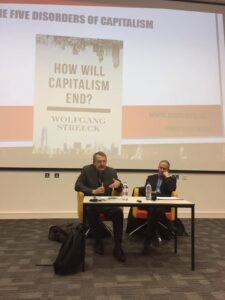
It was an exciting initiative, and there was interest from various individuals and departments from across the College. I was appointed Co-Director, together with Aeron Davis, then in Media Studies, but whose work probed the worlds of British elites and the power of finance. My own book, The Limits of Neoliberalism, came out a few weeks after I arrived in summer 2014. Johnna brought expertise on household debt and a burgeoning interest in the imaginaries, metaphors and pedagogical approaches, through which ‘the economy’ might be rethought for the post-GFC era. Indeed, it was ESRC funding connected to Johnna’s projects on these issues that originally paid for the creation of this website. Between the three of us, there was an overlapping preoccupation with elite power, finance, financial crisis and the ideologies that underpinned these things (a special issue of Theory Culture & Society that Aeron co-edited with Karel Williams was one of the best explorations of these issues).
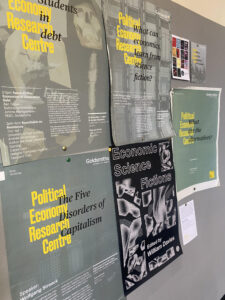 But we also hoped that PERC might be a little different from a wholly academic research centre, with its focus on scholarly papers and seminars. For several years, Johnna, Luna Glucksberg and Clea Bourne coordinated a ‘heretical finance reading group’, that was open to the public, as a means of interrogating finance from heterodox perspectives, and ideally a form of wider public education. Aeron went out and commissioned essays by public figures and engaged academics on the failures of Britain’s economy and its media environment, which later appeared in a book published by the new Goldsmiths Press, The Death of Public Knowledge, which became the first title in the PERC book series. Blogposts flowed in from thinkers and activists outside of the academy, and events featured critical political economists and thinkers whose work spoke to a wider public and to the contemporary moment.
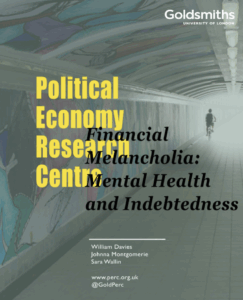
In one particularly fruitful interdisciplinary collaboration, Johnna, Sara Wallin and I combined their research project on acute household indebtedness with my own developing interest in mental health (my book The Happiness Industry having recently been published). The result was an empirical study of the message boards used to discuss crippling consumer debt, and a theory of ‘financial melancholia‘ (pdf) to capture the terrible feelings of remorse and the loss of a viable future that arise, where debt takes over an individual’s sense of temporality and the self.
Meanwhile, I was hoping to develop a more radically interdisciplinary political economy, that could open up the future to wider possibilities, and seeking a community from across the college to work with. But whenever I fired off a group email to suggest a meeting, the only person who turned up without fail was Mark Fisher, who had recently been given a fractional lectureship in the Department of Visual Cultures. Amidst the hundreds of thousands of words written about Mark since his death in 2017, I’ve often thought that one thing gets overlooked: how unusually reliable and collaborative he was, and generous with his time, compared with so many academics. No wonder he found the ‘market Stalinism’ of the twenty-first century university so intolerable; someone for whom self-organisation and collaboration came so naturally and spontaneously must have found the diktats of managers to be utterly pointless.
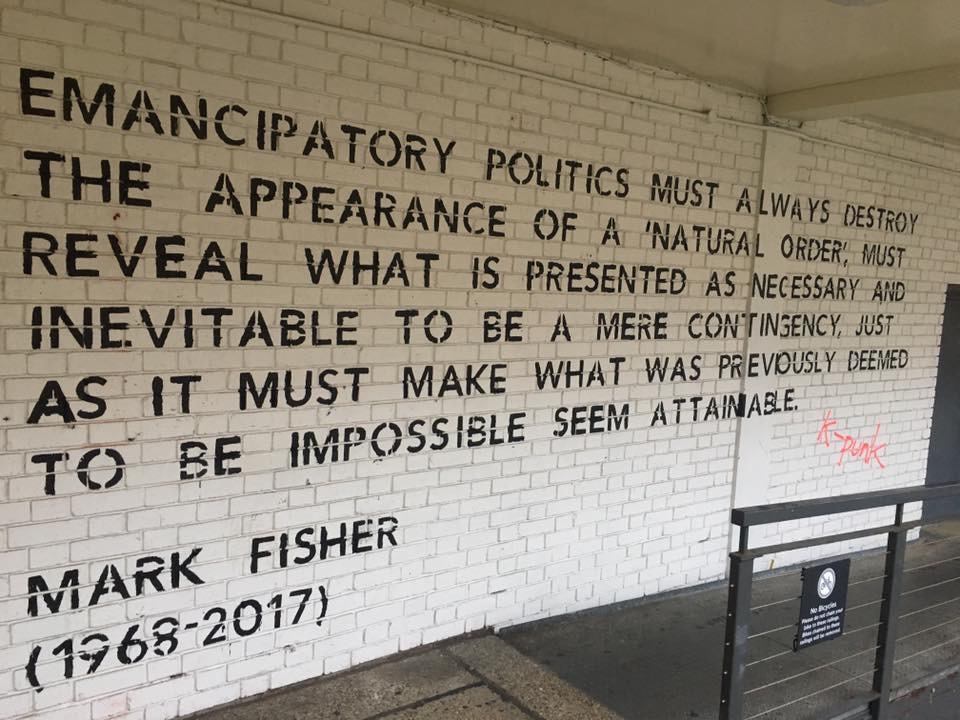
Mark, I and Mao Mollona (Anthropology) began to meet regularly, to try and thrash out the contours of a more imaginative, post-disciplinary vision of political economy, that might point the way to alternative forms of organisation, in which the economic future was subject to a kind of creative design ethos. Unsurprisingly, especially now in hindsight, Mark shied away from any talk of ‘hyperstition’ or ‘acceleration’, but we did hit on the idea of ‘economic science fiction’ as a kind of quasi-utopian genre that might defy the grip of the past over the future, and which might narrow the gap between social science and the humanities. Mao happened to mention that Ha-Joon Chang was a big sci-fi fan, and whose subsequently invited lecture, ‘What can economics learn from science fiction?’, formally launched PERC in 2015. That lecture, together with a wide variety of fictional and social scientific pieces, was included in the next title in the PERC book series, Economic Science Fictions.
New crises
As Britain and the world stumbled from crisis to crisis, this blog and the events we hosted provided what I hope was a valuable space in which to gain some clarity on the present. The Brexit referendum result of 2016 elevated academic questions of ‘populism’, ‘globalisation’ and ‘neoliberalism’ as matters of urgent public interest, and I am proud of how PERC sought to confront these concepts amidst the uncertainty. (One particular blogpost of mine on Brexit, written the morning after the EU referendum after a couple of hours sleep, had a significant impact on my life: it went inexplicably viral, meaning that for a few weeks I was apparently some kind of global expert on what had unfolded, and suddenly publishers and newspapers wanted my writing, some of whom I continue to write for.)
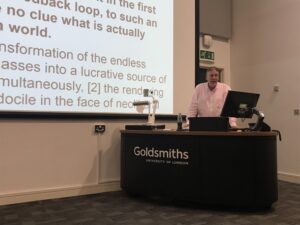
Some of those real-time takes (including my own) were invariably myopic on one dimension. We tended to assume that ‘populism’ represented a push-back against neoliberalism, which it undoubtedly was in rhetoric, but perhaps less so in its effects and beneficiaries. Thus while nationalism might appear to be a harbinger of ‘post-neoliberalism’ (as another special issue of Theory Culture & Society, co-edited by Nick Gane and me, explored), closer attention to neoliberal thought would later problematise this kind of binary split. PERC hosted a small step in that direction in summer 2019, when a seminar organised by then economics lecturer Isabella Weber saw Quinn Slobodian give a paper that he called ‘Hayek’s Bastards’, a kernel (and the title) of what became his award-winning book.
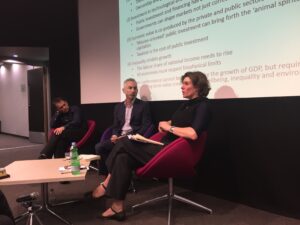
2016 also set PERC off on a separate critical trajectory, thanks to our new affiliation to the ESRC Centre for Understanding Sustainable Prosperity (CUSP), led by Tim Jackson, which brought in a PhD studentship, held by Richard Douglas, and a Post-doctoral Fellow, Nick Taylor. The three of us began to interrogate the moral and political economy of growth, de-growth, and the anthropocene, including how instruments of risk management, scenario planning and inheritance mediate between past, present and future. A host of recent publications – many from Verso – had recently appeared, concerned with the interaction of capitalism and nature, many of which we read as part of an ‘anthropocene reading group’ (also, following Johnna and Clea’s model, open to anyone whether inside or outside the academy), with each one being reviewed for this blog (the reviews can be found here). Along the way, we were fortunate to host events with key thinkers from this genre, including Jason Moore, Andreas Malm, Geoff Mann and Brett Christophers. The fruits of Richard’s PhD have now appeared in a thoughtful interdisciplinary monograph, on the hidden theological underpinnings of growth discourses.
The question of ‘the future’ had become a growing empirical question for a number of economic sociologists at the same time, several of whom Nick was engaging with in his work on expert framings of future climate events (see this paper for example). An event in late 2017 brought together Jens Beckert, Liliana Doganova and Fabian Muniesa to share their work on this, which in some ways fed back into the themes of ‘economic science fictions’. One of my own CUSP outputs was this paper, that sought to think across these different registers, to consider the future as a matter of fiction, imagination, prediction and hope all at once.
New collaborations
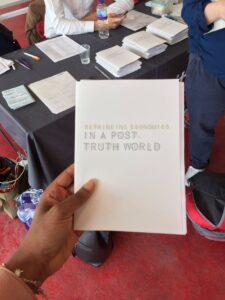
A decade on from the GFC, it was the same question of the future – and how to open up a different one – that provided the impetus for one of the more remarkable events hosted under PERC’s name, this annual conference of the PPE-student-led New School Economics. That student society (and the cohort of 2015-18 especially – see their report from the 2017 Festival of New Economicw Thinking) enriched PERC in all sorts of surprising ways, demonstrating what is possible when pedagogy and research are blended without regard for ‘outcomes’, but purely out of a desire to expand the limits of what is understandable and possible. Here was an inspiring case of young people reading and reflecting on political economy in order to make sense of their generation’s predicament, examining those links that Mark had first illuminated between the closure of the future and psychological distress.
Another manifestation of PERC’s pedagogical value was the new MA in Global Political Economy that was launched soon after Sahil Dutta joined us. As Sahil’s blogpost announcing the MA indicated, this directly channeled the thinking that Nick and others had been doing on the ‘political economy of the anthropocene’ (not an uncontroversial concept, as Geoff Mann’s contribution to our conference on the topic, later published by Boston Review, expressed). The new MA produced a vibrant postgraduate community in and around PERC for a few years before the programme was afflicted by the sector-wide collapse of international postgraduates that occurred in 2023-24, and forced to close.
Around the same time, Sahil brought together PERC with the Critical Finance Group based at Warwick, to host a workshop on Critical Macro-Finance, which was then a relatively novel way of understanding the intersection of financial markets, monetary policy and sovereign debt, as had been advanced in Adam Tooze’s 2018 book Crashed. That workshop saw Daniela Gabor present a version of the paper that later appeared as ‘The Wall Street Consensus’, a lens through which she has analysed the ‘de-risking state’ in the years since, and resulted in a Forum of papers (by Sahil, Daniela and others) published by Finance & Society to lay out the agenda of ‘critical macro-finance’
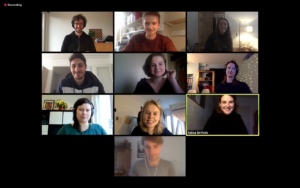
The Covid-19 pandemic was a whole different type of crisis for those seeking to understand the present, afflicting not just the content of what they studied, but the means by which they were able to study it. As we all retreated into our homes and onto our screens in March 2020, we wouldn’t have known that universities would not reassemble in person for another 18 months, and never quite to the same extent again. PERC sought to respond to the times with a further set of reflections and online events, but we also changed what we did. Virtual events and podcasts meant that speakers – and interviewees – no longer had to be in London, offering new ways of sharing ideas (sadly, most of the podcast series was lost due to a lapsed Soundcloud account!). This sudden ‘platformisation’ of the university was of a piece with a wider platformisation of everyday lives and markets, as PERC doctoral student Nils Peters and his collaborators explored.
Covid also provided the pretext for one of PERC’s more ambitious research initiatives: a rapid response, co-authored book, aiming for a conjunctural analysis.Nick, Sahil, Martina Tazzioli and I set about assembling and analysing as much evidence as we could across four key areas of British society – sovereign debt, borders, work and education – in an effort to grasp what kinds of power and inequalities were suddenly on display, in the absence of everyday liberal exchange and activity. The result appeared in April 2022, Unprecedented?: How Covid-19 Revealed the Politics of Our Economy. At the heart of everything, so it seemed to us, was a new problem of staying home, but where ‘home’ had been reconfigured by the politics of finance, infrastructure, work and human capital formation. That then became the basis of a co-authored paper, Stay Home: Mapping the New Domestic Regime.
One further research collaboration is worthy of note, conceived by a former PERC doctoral student and later UEA postdoc Carla Ibled. Carla’s post-doc studied new frontiers of neoliberal ideology, with PERC as a partner to support public engagement and dissemination. A series of blogposts on ‘Silicon Valley ideology‘ contains a number of striking contributions and ideas, many of which have proved prescient given the encroaching political power and rightwing turn of Silicon Valley.
Lessons?
I am conscious in writing this of how elegiac it might seem, which in a way it is. The 2020s have not been kind to higher education in the UK, and Goldsmiths has suffered widely reported struggles. It’s palpable that a great deal of the events and publications detailed above occurred in the first half of PERC’s twelve-year existence. Be that as it may, I want to end with some brief reflections on what might be learnt from the short life of a small research centre such as this.
What strikes me in retrospect, but which was also apparent at the time, is how incredibly efficient PERC was. Scholars from other universities were sometimes surprised to learn that it was only ever – at most – a website, a couple of social media feeds, and three or four academics pooling their shared interests and time, while drawing on the available spaces offered on campus. Being in London offered the unfair advantage of access to international speakers who were often passing through to promote books or participating in other events nearby. It was, in the jargon of welfare economics, an instance of ‘positive externalities’ and informal collaboration, and never of management or of large-scale funding, though the association with ESRC-funded projects (Johnna’s projects, CUSP and Carla’s UEA post-doc) was richly generative along the way.
Over the past decade, most universities in Britain have experienced centralisation of managerial control, even those that are swimming in surpluses. The petty bureaucratic meddling that Mark found so absurd is something that academics have now largely accepted as part of their working environment. As universities in general have come to pay ever more attention to their brands, and allocate ever more budget to marketing, so the freedom of academics to just do stuff, publish things, intervene publicly has been curtailed. Logics of evaluation, impact, reputation metrics, marketing, all dampen those ‘positive externalities’ that arise when people discover that they are excited by some of the same things, and have a bit of spare time to explore them.
It is now widely recognised (including by government reviews and rightwing think tanks) that audit culture and marketization of universities has diverted far too much attention towards centrally-managed communications, marketing and managerialism. For a while, and on an admittedly small scale, PERC provided an example of how collaborative spirit, public engagement, critical imagination and interdisciplinarity could maybe achieve more intellectually and reputationally than officially-licensed and tightly-managed research programs might do. In ever-more straitened times, maybe we need more of that kind of ‘efficiency’, not less.
The PERC blog will remain online until early 2027, whereupon it will be archived.
Discuss this article